
The Airline Safety Card For Business Networking
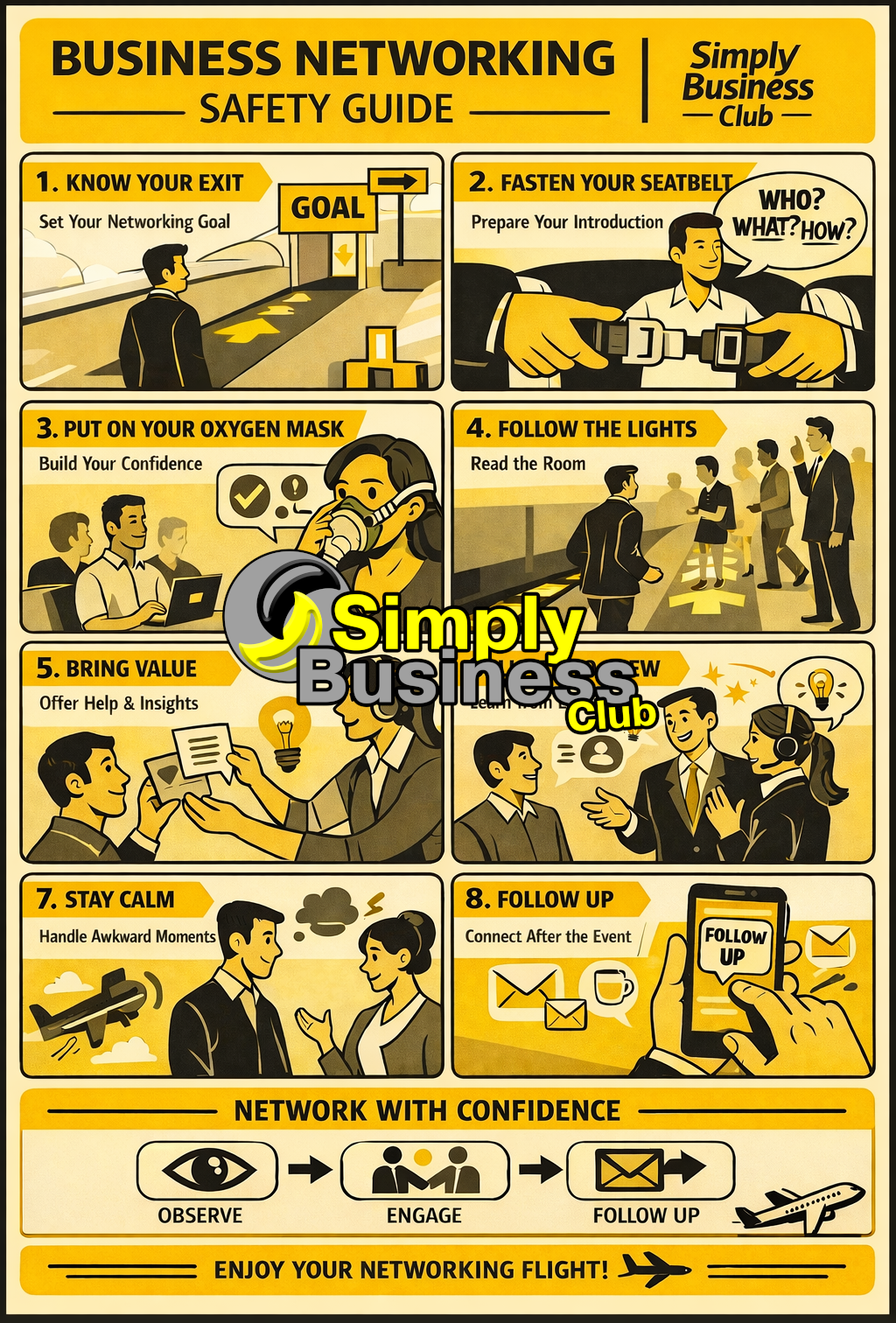
The Airline Safety Card for Business Networking
What Business Networking Can Learn From the Safety Card in Your Seat Pocket
If you’ve ever flown on an aeroplane, you’ll be familiar with the airline safety card tucked into the seat pocket in front of you. It’s a simple, visual guide explaining what to do before take-off, during the flight, and in the unlikely event of an emergency.
Most passengers give it a quick glance before putting it back — but its purpose is important: to make sure everyone knows how to navigate the journey safely and confidently.
Business networking can sometimes feel a little like boarding a flight for the first time. You enter a room full of people, conversations are happening in every direction, and it’s not always obvious where to start or how to make the most of the experience.
Just like flying, networking becomes much easier when you understand a few simple principles.
So imagine if there were a “business networking safety card” — a quick guide to help you prepare for the event, handle conversations with confidence, and make the most of the opportunities around you.
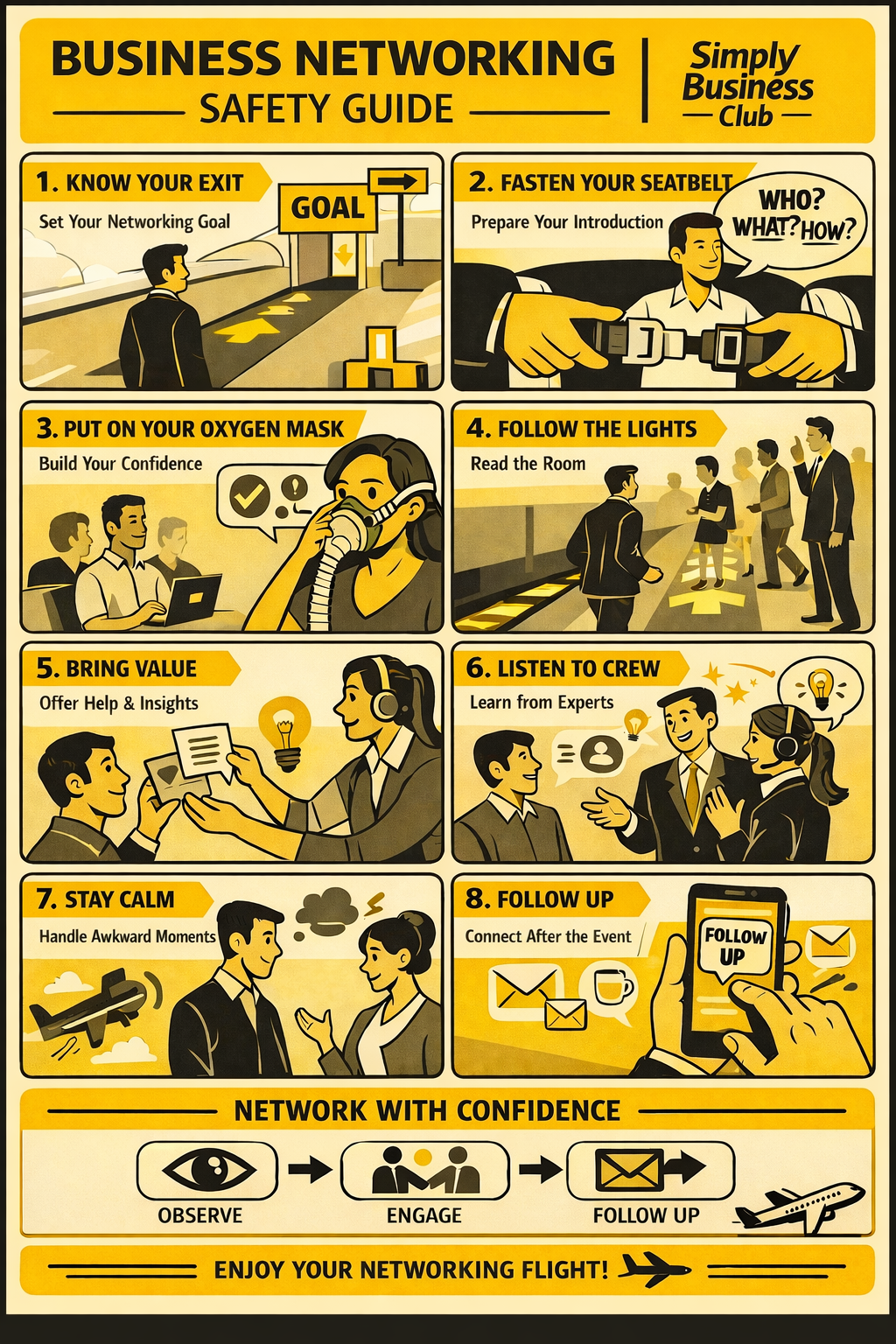
Here’s what that networking safety card might include.
1. Locate Your Nearest Exit (Know Why You’re There)
One of the first instructions on an airline safety card is to locate the nearest emergency exit. The crew remind passengers that the closest exit might not be the one directly in front of them — it could be behind them or to the side.
In networking, the equivalent is understanding your purpose for attending the event before you even arrive.
Without a clear objective, networking can feel unfocused. You may find yourself drifting from conversation to conversation without knowing whether you’re actually moving closer to your business goals.
Before attending a networking meeting, ask yourself a few simple questions:
- Are you looking to meet potential clients?
- Do you want to build relationships with referral partners?
- Are you exploring collaboration opportunities?
- Are you primarily there to raise your visibility in the local business community?
Knowing your purpose doesn’t mean limiting your conversations. In fact, it often helps them become more meaningful because you’re aware of what you’re looking for and how you can help others in return.
Just like knowing the nearest exit on a plane, having a sense of direction makes the journey far easier.
2. Fasten Your Seatbelt (Prepare Your Introduction)
Every safety demonstration begins with the same instruction: fasten your seatbelt securely.
It’s simple, practical, and essential.
In business networking, your “seatbelt” is your introduction — sometimes called your pitch. It doesn’t need to be complicated, and it certainly doesn’t need to sound rehearsed. But it should be clear enough that someone hearing it for the first time can understand what you do and who you help.
A strong networking introduction usually answers three straightforward questions:
- Who do you help?
- What challenge do they face?
- What outcome do you help them achieve?
When you prepare your introduction in advance, it gives you confidence. Instead of worrying about what to say, you can focus on engaging with the person in front of you.
Just like fastening your seatbelt before take-off, a well-prepared introduction ensures you’re ready for the journey ahead.
3. Secure Your Own Oxygen Mask First (Build Your Confidence)
One of the most memorable instructions during an airline safety briefing is to secure your own oxygen mask before helping others.
The logic is clear: if you’re not able to breathe properly, you can’t assist anyone else.
In networking, the equivalent is confidence. If you’re unsure about how to describe your business or hesitant to start conversations, it becomes difficult to help others understand the value you bring.
Confidence doesn’t mean dominating the room or delivering a polished speech. It simply means being comfortable enough to explain your work and listen to others without feeling pressured.
Confidence grows through practice. The more networking events you attend, the more natural conversations become.
When you feel comfortable explaining what you do, people respond positively — and that makes networking easier for everyone involved.
4. Follow the Illuminated Path (Pay Attention to the Room)
Airline safety cards show illuminated pathways along the aircraft floor that guide passengers to the exits in low visibility conditions.
In networking, this “pathway” is your awareness of the room.
Successful networkers pay attention to the environment around them. They notice who is already deep in conversation, who is standing alone, and where there are natural openings for discussion.
Reading the room also means understanding the atmosphere. Some networking events are lively and fast-paced, while others are quieter and more reflective. Adjusting your approach to match the environment helps conversations feel more natural.
Observation is one of the most underrated networking skills. By paying attention first, you can engage more effectively when you join a conversation.
5. Locate Your Life Jacket (Bring Something Valuable)
On a plane, the safety card explains where your life jacket is located and how to use it in an emergency.
In networking, your “life jacket” is the value you bring to conversations.
Value can take many forms:
- Sharing useful knowledge
- Offering a helpful suggestion
- Introducing two people who should meet
- Recommending a resource or contact
- Offering encouragement or insight
Networking works best when it’s collaborative rather than transactional. The more helpful you are to others, the more memorable you become.
People naturally gravitate towards those who contribute positively to the room.
6. Listen to the Cabin Crew (Learn From the Experienced Networkers)
During every flight, cabin crew guide passengers through procedures and provide assistance when needed. Their experience helps everything run smoothly.
At networking events, there are often people who understand the flow of the room particularly well. These may be event organisers, regular attendees, or experienced networkers who know how to connect people effectively.
Instead of focusing only on your own pitch, observe how these individuals interact. Notice how they introduce people, ask questions, and move between conversations.
You’ll often learn valuable networking skills simply by watching how experienced networkers engage with others.
7. Stay Calm During Turbulence (Not Every Conversation Will Be Perfect)
Even the smoothest flights occasionally encounter turbulence. When it happens, the most important thing is to remain calm and trust the process.
Networking can feel similar. Some conversations will flow effortlessly, while others may feel slightly awkward or brief.
That’s completely normal.
Not every interaction needs to lead to a business opportunity. Sometimes the value of networking lies in simply becoming familiar to others. Over time, those small interactions build trust and recognition.
The key is to remain relaxed and open to the experience.
8. Remember the Journey Continues After Landing (Follow Up)
A flight doesn’t end when the wheels touch the runway. Passengers still disembark, collect their luggage, and continue their journey.
Networking works the same way.
The real value of networking often happens after the event. Following up with the people you met helps transform a short conversation into a genuine relationship.
A simple message might include:
- Thanking them for the conversation
- Referencing something you discussed
- Sharing a helpful resource
- Suggesting a future meeting
This small step shows professionalism and keeps the relationship moving forward.
Why the “Safety Card” Approach Works
Airline safety cards are designed to be simple, visual, and easy to understand. They focus on essential actions rather than complicated instructions.
Networking benefits from the same simplicity.
You don’t need elaborate strategies or scripted conversations. Instead, focus on a few core principles:
- Clarity in how you introduce yourself
- Genuine interest in others
- Awareness of the room
- Willingness to contribute
- Consistent follow-up
When you approach networking with these fundamentals in mind, the experience becomes far less intimidating — and far more productive.
If business networking had an airline safety card, it would remind us of something simple: preparation, awareness, and good communication make the journey smoother for everyone.
When you enter a networking room with confidence, curiosity, and a willingness to help others succeed, connections happen naturally.
At Simply Business Club, we believe networking should feel supportive, collaborative, and purposeful. And when you follow the right “flight instructions”, the opportunities that follow can help your business truly take off.
Simply Business Club want to get you along to one of our upcoming Face-to-Face or Online Business Networking meetings soon
At Simply Business Club, our mission is simple: to bring business owners together in a way that builds authentic relationships and leads to real, measurable outcomes.
Whether you’re looking to raise your profile, position yourself as a trusted expert, or develop partnerships that deliver long-term value, our meetings are designed to help you network with purpose. Each event creates the right environment for confident collaboration, engaging conversation, and the sharing of ideas that help businesses move forward.
What truly makes SBC different from many networking groups across the UK is the culture we’ve built. It’s friendly, welcoming, and genuinely supportive — a place where conversations happen naturally, ideas are exchanged openly, and trust grows through honesty, respect, and meaningful connection.
Our members come from every corner of the business landscape, from ambitious start-ups and independent professionals to established and growing SMEs. What connects them all is a shared belief that success becomes more powerful when it’s shared. This mindset has helped shape Simply Business Club into a thriving community built on collaboration, encouragement, and collective progress.
Joining Simply Business Club isn’t about collecting contacts. It’s about opening doors to new opportunities, gaining fresh insight, and becoming part of a dynamic business community where both companies — and the people behind them — are supported to grow and succeed together.
Contact us at Simply Business Club today and learn more about our upcoming business networking meetings.